Jaw pain, facial pain, and headaches caused by the temporomandibular
joint deserve specialist diagnosis — not guesswork or indefinite pain management.
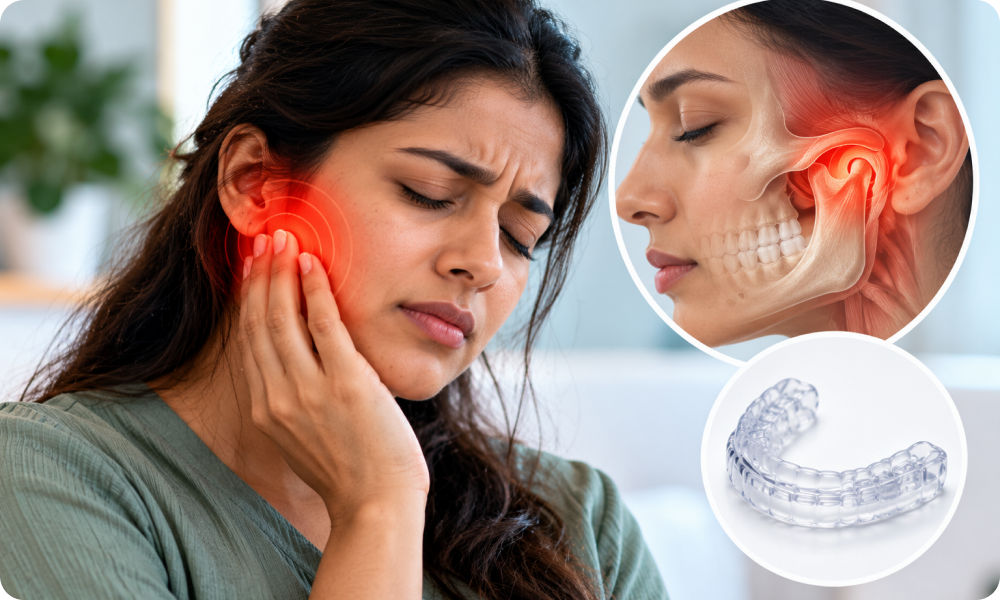
TMJ pain is rarely simple. The joint and the muscles that move it — the masticatory muscles — share a dense network of nerve supply with the face, head, neck, and ears. Pain originating in the jaw can manifest as ear pain, temple headache, neck stiffness, tooth sensitivity, or diffuse facial aching that sends patients to GP, ENT, and neurology clinics before anyone looks at the jaw.
The key to resolution is accurate localisation of the pain source. At I Smile Clinic, Dr. Anu uses a structured diagnostic protocol: pain history, palpation mapping, provocation testing, and where needed, diagnostic blocks (anaesthetic injections that temporarily eliminate a suspected pain source) to confirm origin. A diagnosis made on history alone is rarely sufficient for a condition this complex.
Treatment is always conservative-first. The vast majority of TMJ pain patients improve significantly — often dramatically — with occlusal splint therapy, trigger point injections, and patient education around parafunctional habits. Invasive interventions are reserved for cases that have genuinely failed thorough conservative management.
Book a consultation with our specialists and receive a personalized treatment plan.

Sudden onset of severe jaw or facial pain — often triggered by prolonged opening, dental treatment, or stress — requiring prompt conservative management.

Persistent aching in the masticatory muscles, often with trigger points that refer pain to distant sites including the temple, ear, and neck.

Pain localised to the joint area that worsens with chewing, yawning, or wide opening — often accompanied by clicking or restricted movement.

Prolonged opening during dental procedures can strain the TMJ — causing post-treatment pain that may persist for weeks without specialist management.

Bruxism places enormous compressive and lateral loads on the TMJ — causing morning jaw pain, stiffness, and headache that worsen without intervention.

Sudden, electric-shock facial pain may originate in the TMJ and masticatory muscles rather than the trigeminal nerve — requiring careful differential diagnosis.

A structured 60-minute consultation documents pain location, character, intensity, onset, triggers, and response to previous treatments.

Targeted clinical tests reproduce and localise the pain — distinguishing joint pain from muscle pain and ruling out non-TMJ causes.

CBCT when bony joint pathology is suspected; MRI referral when disc position needs assessment. We do not image routinely — only when it changes management.

An occlusal splint is fabricated, trigger point injections administered if indicated, and a home therapy protocol prescribed. Outcomes are measurable from the first 2–3 weeks.

TMJ pain conditions often wax and wane. We provide a maintenance strategy — including what to do during flares — that empowers patients to manage their condition long-term.
Toothache is typically localised to a specific tooth and worsens with temperature (hot or cold). TMJ pain is more diffuse, involves the joint or jaw muscles, and worsens with jaw movement rather than temperature. A clinical examination quickly differentiates the two.
The goal is to resolve the underlying source of pain, not to manage it with medication indefinitely. Most patients reduce or eliminate pain medication within 8–12 weeks of beginning a structured treatment plan.
Yes — directly. Psychological stress is one of the most potent drivers of jaw clenching and grinding, which loads the TMJ and masticatory muscles. Addressing the behavioural component of bruxism is essential for lasting pain relief.
An orofacial pain specialist — like Dr. Anu — sits at the intersection of dentistry and pain medicine and is the most appropriate first referral for jaw and facial pain. Many patients arrive after seeing multiple other specialists without resolution.

The temporomandibular joint connects your jaw to your skull. When it malfunctions, the effects ripple far beyond the jaw itself — causing pain, clicking, and restricted movement.

Accurate classification of your specific TMJ disorder is the foundation of effective treatment. Dr. Anu uses evidence-based diagnostic criteria (DC/TMD) to classify and target your condition precisely.

Specialized treatment for TMJ disorders, facial pain, and myofascial pain. We use advanced diagnostic techniques to identify the root cause and provide targeted relief.
Our specialists will evaluate your case and design a treatment plan built around your goals.