Obstructive sleep apnea is treatable — and dental oral appliance therapy
offers an effective, comfortable alternative to CPAP for millions of patients.
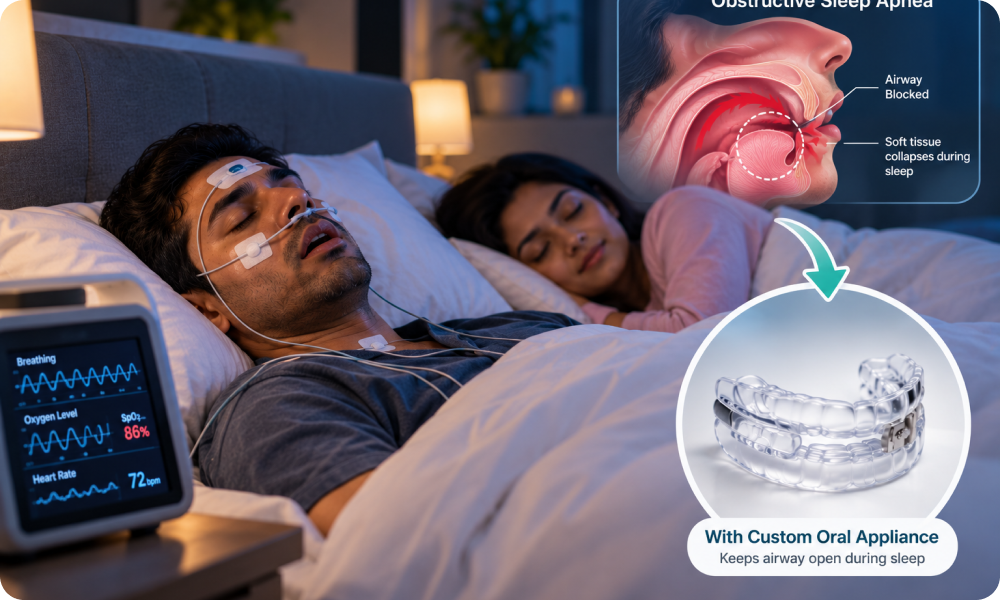
Obstructive sleep apnea (OSA) is defined by recurrent episodes of partial or complete upper airway collapse during sleep — causing oxygen desaturation that can occur hundreds of times per night. The consequences extend far beyond poor sleep quality: untreated OSA is an independent risk factor for hypertension, atrial fibrillation, type 2 diabetes, stroke, and cardiovascular mortality.
CPAP (continuous positive airway pressure) is the gold standard for severe OSA — but real-world compliance rates are poor. Studies consistently show that 30–50% of patients abandon CPAP within the first year. For mild-to-moderate OSA, and for patients with severe OSA who cannot tolerate CPAP, oral appliance therapy (OAT) is a first-line recommended alternative.
Custom mandibular advancement devices advance the lower jaw 5–10mm during sleep, tensioning the tongue and pharyngeal muscles and preventing airway collapse. They are silent, compact, travel-friendly, and have compliance rates that substantially exceed CPAP in head-to-head comparisons.
Book a consultation with our specialists and receive a personalized treatment plan.

Oral appliance therapy is a recommended first-line treatment — often producing complete normalisation of the apnea-hypopnea index.

OAT is effective and recommended as an alternative to CPAP, particularly when CPAP compliance is poor or patient preference favours an appliance.

Patients who cannot tolerate CPAP have a well-supported alternative. OAT may not fully normalise AHI in severe cases but produces clinically meaningful reductions.

Patients whose apnea occurs primarily supine (on the back) often respond especially well to oral appliances.

Sleep bruxism is significantly more prevalent in OSA patients — treating the airway often reduces grinding as a consequence.

Children with OSA present differently from adults — with behavioural changes, hyperactivity, and learning problems. Assessment and early intervention are critical.

STOP-BANG questionnaire, Epworth Sleepiness Scale, and clinical airway evaluation establish pre-test probability of OSA.

A home sleep test or in-lab polysomnography confirms diagnosis, quantifies severity (AHI), and characterises oxygen desaturation.

Jaw range of motion, periodontal status, and dental health are assessed to confirm suitability for appliance therapy.

Digital scans are used to fabricate a precision custom MAD. The appliance is fitted at the starting advancement position and instructions given.

The appliance is gradually advanced over several visits to the therapeutic position. A repeat sleep study confirms AHI reduction. Results are shared with the referring sleep physician.
Common signs: loud snoring, waking with a gasp or feeling unrefreshed, excessive daytime sleepiness, morning headaches, and a bed partner reporting witnessed apneas. A sleep study is required for diagnosis.
For mild-to-moderate OSA, clinical outcomes are comparable. CPAP achieves slightly greater AHI reduction on average, but oral appliances have significantly higher real-world compliance — which ultimately determines health outcomes.
Most patients notice improved sleep quality within the first week of wearing the appliance. Objective confirmation of AHI reduction requires a follow-up sleep study, typically conducted 4–8 weeks after reaching the therapeutic advancement.
Weight loss is the only intervention that can produce sustained remission in overweight patients. For most patients, OSA is a chronic condition requiring long-term management — whether with CPAP, an oral appliance, or (in selected cases) surgery.

Custom oral appliances reposition the jaw during sleep to open the airway and eliminate or significantly reduce snoring — without masks, machines, or surgery.

Comprehensive treatment for sleep disorders, snoring, and sleep apnea to improve your quality of life.

Specialized treatment for TMJ disorders, facial pain, and myofascial pain. We use advanced diagnostic techniques to identify the root cause and provide targeted relief.
Our specialists will evaluate your case and design a treatment plan built around your goals.