
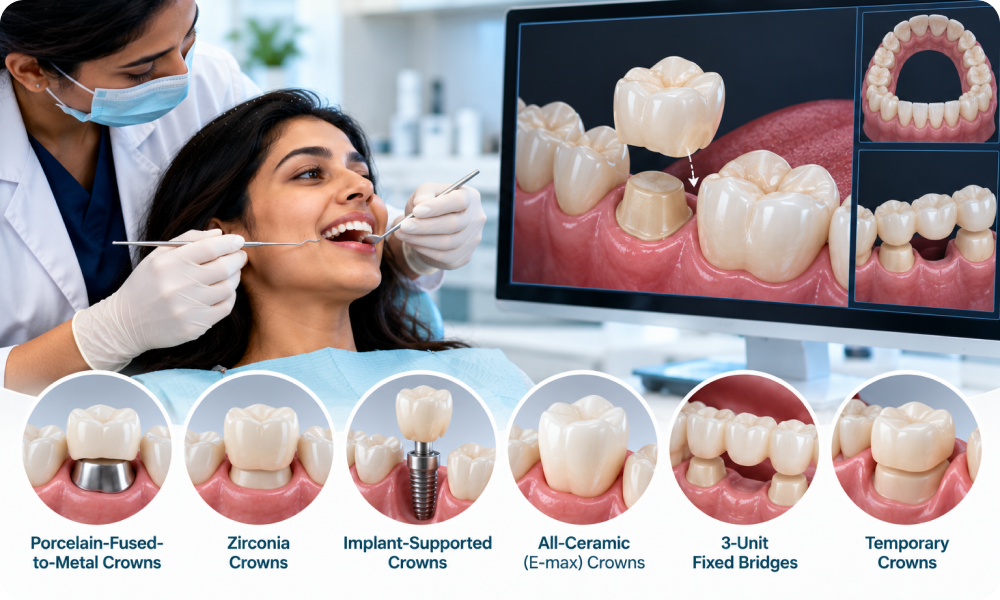
Ceramic crowns and bridges restore broken, damaged, or missing teeth
withrestorations that are strong, natural-looking, and built to last.
A dental crown is a full-coverage restoration that caps a tooth to restore its shape, size, strength, and appearance. Unlike a filling — which fills a void within the tooth — a crown encircles the entire visible portion, protecting the remaining tooth structure from fracture forces. Crowns are indicated when a tooth has lost too much natural structure to be reliably restored with a filling.
Fixed dental bridges replace one or more missing teeth by spanning the gap using the adjacent teeth as abutment supports. The bridge is cemented permanently and functions like natural teeth — no removal, no adhesives, no instability. The trade-off is that the adjacent teeth require crown preparation, even if they were previously healthy.
All restorations at I Smile Clinic are metal-free wherever clinically indicated — using lithium disilicate (IPS e.max) or zirconia ceramics. These materials match tooth colour with extraordinary precision, have excellent compressive strength, and contain no dark metal margins that darken the gum line over time. Digital shade selection ensures every crown is indistinguishable from its neighbours.
Book a consultation with our specialists and receive a personalized treatment plan.

Teeth that have lost more than 50% of their crown volume to decay or fracture require a crown to prevent catastrophic fracture under biting forces.

Non-vital teeth become brittle over time and are at high risk of fracture without crown coverage — especially posterior teeth under significant occlusal load.

Teeth with symptomatic vertical cracks are stabilised by a crown that bonds and supports the cracked segments — often eliminating symptoms completely.

A three-unit bridge — two crowned abutment teeth flanking a suspended false tooth (pontic) — replaces a missing tooth without the surgical component of an implant.

A ceramic crown cemented or screw-retained onto a dental implant completes the restoration, creating a tooth indistinguishable from its neighbours in appearance and function.

Old metal or metal-ceramic crowns with dark margins are replaced with modern all-ceramic alternatives for dramatically improved aesthetics.

The tooth is assessed for restorability — sufficient bone support, adequate remaining structure, and absence of unresolvable pathology are confirmed before preparing any crown.

The tooth is reduced uniformly to create space for the crown. The preparation design and dimensions follow the requirements of the chosen ceramic material.

An intraoral scan captures the preparation and adjacent teeth with sub-millimetre accuracy — eliminating the need for a physical impression and reducing the chance of errors.

A well-fitting temporary crown protects the prepared tooth and maintains aesthetics while the permanent crown is fabricated — typically 5–10 working days.

The permanent crown is tried in for fit, shade, and bite. Adjustments are made if needed, then the crown is cemented with adhesive resin cement and the bite confirmed.
All-ceramic crowns typically last 10–15 years. Zirconia crowns are demonstrating survival rates that may exceed 20 years. Longevity depends on bite forces, oral hygiene, and whether the crown is maintained with regular professional check-ups.
Tooth preparation is performed under local anaesthesia — painless. Post-operative sensitivity on the prepared tooth is common for 1–2 weeks and resolves once the permanent crown is cemented.
For most patients, an implant is the superior long-term option — it replaces the root, preserves bone, and does not require preparation of healthy adjacent teeth. Bridges are appropriate when implants are contraindicated or when the adjacent teeth already need crowns.
Yes — after the permanent crown is cemented. We recommend caution with the temporary crown: avoid hard, sticky, or very chewy foods that might dislodge the temporary cement.

A titanium post anchored in the jawbone, topped with a custom ceramic crown — the closest science has come to replacing a natural tooth.

When decay or trauma infects the dental pulp, root canal treatment removes the source of pain and infection — preserving the natural tooth for years to come.

Ultra-thin porcelain shells bonded to the front surface of teeth — changing their colour, shape, and size in a single transformative procedure.
Our specialists will evaluate your case and design a treatment plan built around your goals.