Intraoral scanning replaces uncomfortable putty impressions with a precise,
comfortable 3D digital capture of your teeth in minutes.
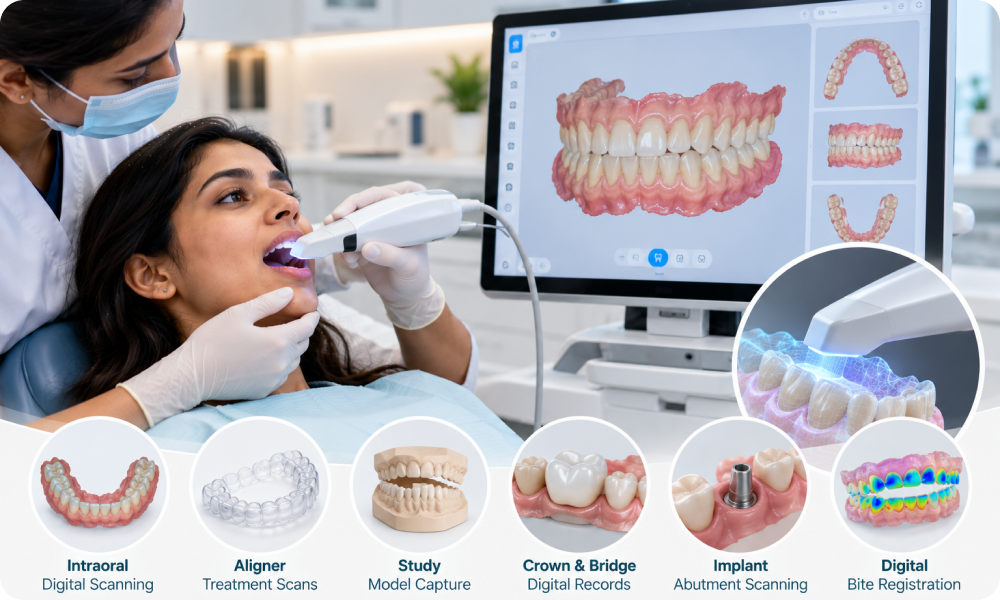
Intraoral scanners capture thousands of images per second as a small handheld wand is moved across the tooth surfaces — stitching them together in real time into a photorealistic 3D model. The scan is complete in 3–5 minutes and immediately available on screen for review. No tray, no putty, no gagging, no waiting for an impression to set.
The accuracy of modern intraoral scanners meets or exceeds that of traditional polyvinyl siloxane impressions for most clinical applications. For implant restorations involving multiple units, the error accumulation of physical impressions over long spans actually makes digital scanning more accurate. All crowns, aligners, retainers, and study models at I Smile Clinic are produced from digital scans.
Beyond comfort and speed, digital records have a transformative long-term advantage: permanent storage. Your 3D model from today can be compared to a scan taken in five years — revealing subtle tooth movement, wear, or dimensional changes that would otherwise go undetected. This longitudinal data supports better clinical decisions over the lifetime of your care.
Book a consultation with our specialists and receive a personalized treatment plan.

Digital scans feed directly into the CAD/CAM workflow for same-day or next-day ceramic fabrication with laboratory-quality fit.

Every aligner course begins with a digital scan — the foundation of the 3D treatment simulation and the manufacturing data for each aligner set.

Scanning over implant scan bodies captures the precise three-dimensional position of osseointegrated implants for custom abutment and crown design.

Digital study models replace plaster casts — stored permanently, retrievable instantly, and shareable with referring clinicians electronically.

Custom retainers are fabricated from the final aligner or post-treatment digital scan — ensuring a precise fit every time.

Before-and-after digital scans provide objective, measurable documentation of tooth position changes — for clinical review and patient communication.

Teeth are dried briefly if needed. No tray selection, no mixing, no waiting for material to set. The wand is warmed to body temperature before scanning.

The wand moves methodically across all tooth surfaces — typically upper arch, lower arch, and bite registration — in 3–5 minutes.

The 3D model appears on screen as the scan progresses. Any gaps are immediately identified and rescanned. You can see your own teeth in three dimensions before leaving the chair.

Margin accuracy, interproximal contacts, and bite registration are verified digitally before the scan is submitted for any fabrication workflow.

The scan file is transmitted directly to the aligner laboratory, the in-house milling unit, or the digital dental laboratory — initiating fabrication without physical handling or shipping of impressions.
Yes. Intraoral scanners achieve marginal fit accuracy comparable to polyvinyl siloxane impressions for single crowns and short bridges. For full-arch implant prosthetics, digital scanning is more accurate because it eliminates impression material distortion.
Yes. The scanner captures whatever is present in the mouth — whether natural tooth structure, existing restorations, or implant scan bodies. It is not affected by the material.
No. Intraoral scanning captures tooth surface geometry in 3D. X-rays capture internal tooth structure, bone levels, and root anatomy. They provide complementary information and are both required for comprehensive dental records.
For the vast majority of clinical situations, no. Some niche laboratory workflows still use physical models — but these are increasingly rare as CAD/CAM fabrication has become the standard.

CBCT scanning transforms dental diagnosis and treatment planning — revealing anatomy invisible on conventional X-rays and enabling guided surgery with unmatched precision.

State-of-the-art dental technology including laser dentistry, 3D imaging, and digital smile design for precise, comfortable treatment.

A titanium post anchored in the jawbone, topped with a custom ceramic crown — the closest science has come to replacing a natural tooth.
Our specialists will evaluate your case and design a treatment plan built around your goals.