Any change in the colour, texture, or surface of your oral soft tissues warrants
professional evaluation — early detection of oral pathology saves lives.
The oral cavity is lined with mucosal tissue that can develop a wide range of lesions — from trivial aphthous ulcers to the earliest manifestations of oral squamous cell carcinoma, one of the most common cancers worldwide. The ability to distinguish between benign, potentially malignant, and frankly malignant lesions requires systematic training and clinical experience.
Oral cancer has one of the most favourable prognoses of all cancers when detected early — five-year survival exceeds 80% for Stage I disease. Late detection, which remains the norm globally because of inconsistent screening, reduces this to under 30%. Every dental check-up at I Smile Clinic includes a systematic soft tissue examination for exactly this reason.
Not all oral lesions are sinister. The vast majority are benign — traumatic ulcers, aphthous stomatitis, fibrous epulis, mucocele. Expert clinical assessment determines which require monitoring, which require treatment, and which require biopsy and onward referral. We do not biopsy everything — but we have a low threshold when any feature suggests potential malignancy.
Book a consultation with our specialists and receive a personalized treatment plan.

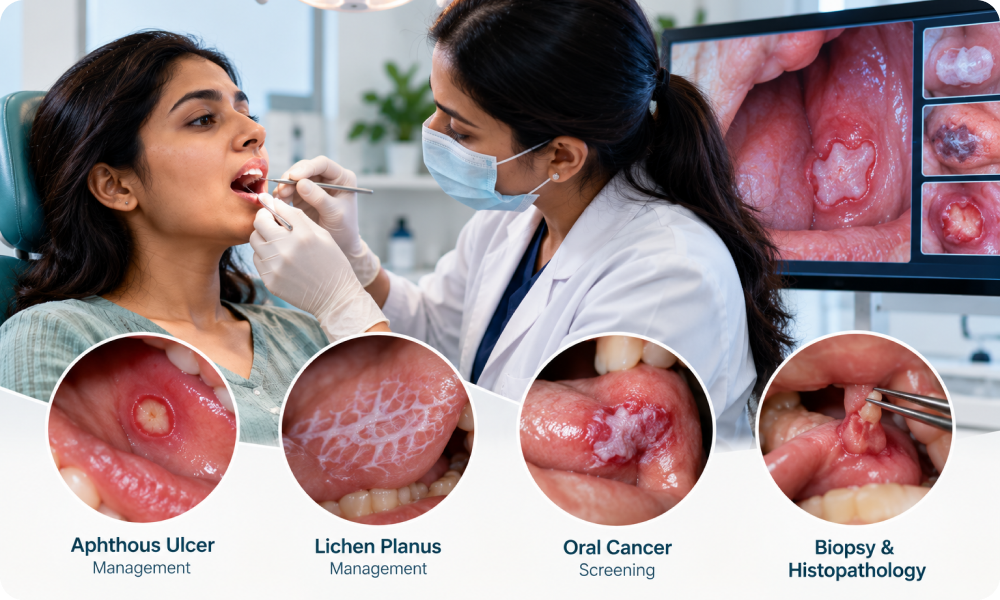
Recurrent painful ulcers of the non-keratinised mucosa — extremely common, benign, and manageable but sometimes a marker of systemic disease.

White patches that cannot be rubbed off and have no other clinical explanation — a potentially pre-malignant lesion requiring biopsy if persistent.

Red velvety patches — rarer than leukoplakia but carrying a significantly higher risk of malignant transformation. Always requires biopsy.

A chronic autoimmune condition producing white striae, erosions, or painful ulcers of the oral mucosa — requiring diagnosis confirmation and long-term management.

The most common oral cancer — presenting as a non-healing ulcer, white/red patch, or exophytic growth. Early detection by routine examination is the most effective intervention.

Benign proliferations of fibrous tissue or mucous retention cysts — common, easily excised, and almost never malignant but requiring diagnosis to confirm.

All mucosal surfaces — lips, buccal mucosa, floor of mouth, tongue (including underside), hard and soft palate, and oropharynx — are examined systematically at every visit.

Any abnormality is photographed, measured, and described — location, size, colour, surface character, borders, consistency. This baseline determines whether the lesion is changing.

Traumatic lesions are given 2–3 weeks to resolve. Any lesion persisting beyond 3 weeks, or any lesion with features suspicious for malignancy, is biopsied.

A small tissue sample is taken under local anaesthesia and sent for histopathological analysis. Results are available within 7–10 working days.

Confirmed malignant or pre-malignant lesions are referred to an oral and maxillofacial surgeon or head and neck oncologist, with full clinical documentation.
Any mouth sore that persists beyond 3 weeks without healing, or any white or red patch that appears without an obvious cause (trauma, infection), warrants professional evaluation. Do not self-diagnose or wait indefinitely.
A small punch or excisional biopsy of an oral lesion is performed under local anaesthesia. The procedure itself is painless. Mild soreness at the biopsy site for 3–5 days is normal.
The most modifiable risk factors are tobacco use (in all forms), excessive alcohol consumption, and HPV infection. Avoiding tobacco entirely and moderating alcohol consumption dramatically reduces oral cancer risk.
A systematic visual and tactile examination of all mucosal surfaces, the floor of the mouth, and the neck lymph nodes — taking approximately 3–5 minutes as part of every dental check-up. No special equipment is required.

Our comprehensive dental check-up goes beyond a quick look — it is a systematic evaluation of every structure in and around your mouth, delivered by clinicians who take preventive care seriously.

Complete preventive and restorative dental care for the whole family, ensuring optimal oral health at every age.

State-of-the-art dental technology including laser dentistry, 3D imaging, and digital smile design for precise, comfortable treatment.
Our specialists will evaluate your case and design a treatment plan built around your goals.