
A thorough dental check-up every six months is the single most
cost-effective investment you can make in your long-term oral health.
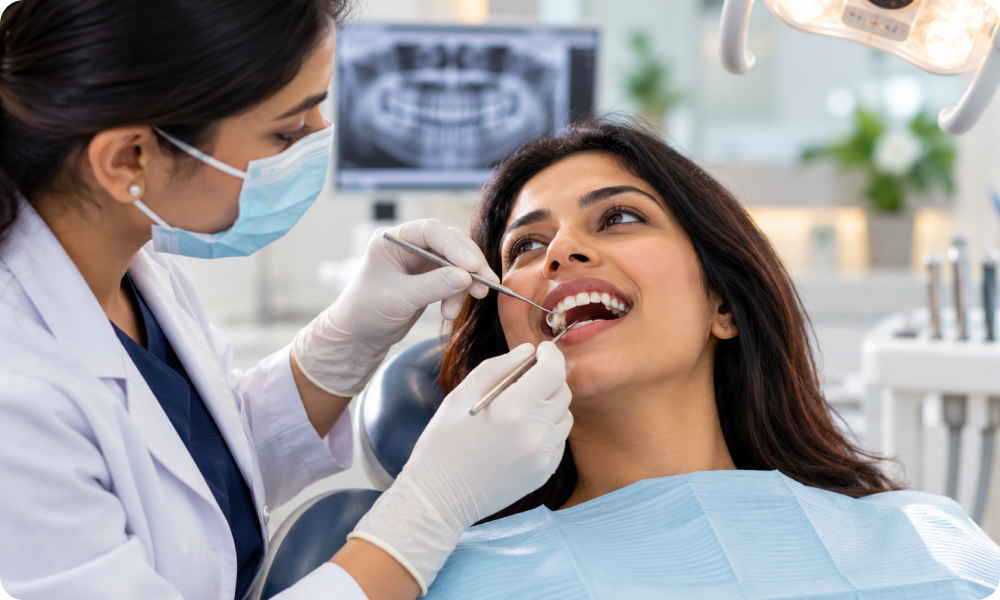
A general dental check-up is not simply a polish and a glance. At I Smile Clinic, every examination is a structured clinical event: a systematic review of all teeth, the periodontium (gums and bone), the bite, the soft tissues, and the temporomandibular joint. Nothing is skipped.
The professional cleaning that accompanies each check-up removes calculus (tartar) that brushing and flossing cannot reach. Calculus is the primary driver of gum disease — which, left untreated, leads to bone loss and eventually tooth loss. Removing it twice a year is the most effective gum disease prevention available.
For patients at higher risk — those with a history of cavities, gum disease, dry mouth, smoking, or poorly controlled diabetes — we increase check-up frequency to 3 or 4 months until risk is controlled. Recall frequency is personalised, not protocol-driven.
Book a consultation with our specialists and receive a personalized treatment plan.

Early cavities between teeth or under old fillings are invisible to the naked eye but detectable on X-rays and with laser fluorescence.

Gingivitis (reversible) and periodontitis (bone-destroying) are identified through gum pocket measurements at every check-up.

Worn or fractured teeth signal occlusal stress — from grinding, clenching, or a bite imbalance — that check-ups detect before teeth fracture.

Systematic soft tissue examination catches suspicious lesions early — when five-year survival rates exceed 80%, versus under 30% for late-stage detection.

Dietary acid or gastric reflux dissolves enamel — a pattern detectable clinically long before patients notice tooth sensitivity.

Old fillings, crowns, and bridges degrade over time. Check-ups identify failing restorations before they fracture and damage the underlying tooth.

We review any changes in your medical history, medications, or systemic health — because many conditions and drugs affect oral health directly.

Every tooth is charted. Gum pockets are measured. The bite is assessed. All soft tissues are examined. The TMJ is palpated.

Bite-wing X-rays are taken at appropriate intervals to detect interproximal decay and bone levels invisible clinically.

Supragingival and subgingival scaling removes all calculus deposits. Polishing removes surface staining.

A home care plan is discussed, findings are explained, and your next recall appointment is scheduled at an interval appropriate to your risk level.
Every 6 months is appropriate for most adults. Patients with active gum disease, high cavity rates, or systemic conditions that affect oral health benefit from 3–4 monthly visits until those risks are controlled.
Absolutely. The majority of dental problems — early decay, gum disease, oral lesions — are completely painless until advanced. Check-ups exist precisely to find problems before they cause pain.
Yes. Modern digital X-rays deliver a radiation dose equivalent to a few minutes of natural background radiation. The diagnostic benefit — detecting decay and bone loss invisible to the naked eye — far outweighs the minimal risk.
We never judge. A thorough assessment gives us a complete baseline — and in most cases, even after a long gap, the majority of issues are addressable. The important thing is starting from where you are now.

From the first invisible mineral loss to a painful abscess, caries follows a predictable path. Understanding each stage helps you make informed decisions about your dental health.

Complete preventive and restorative dental care for the whole family, ensuring optimal oral health at every age.

Systematic examination and expert diagnosis of oral soft tissue changes — from benign ulcers to potentially malignant lesions — with biopsy and onward referral where needed.
Our specialists will evaluate your case and design a treatment plan built around your goals.