
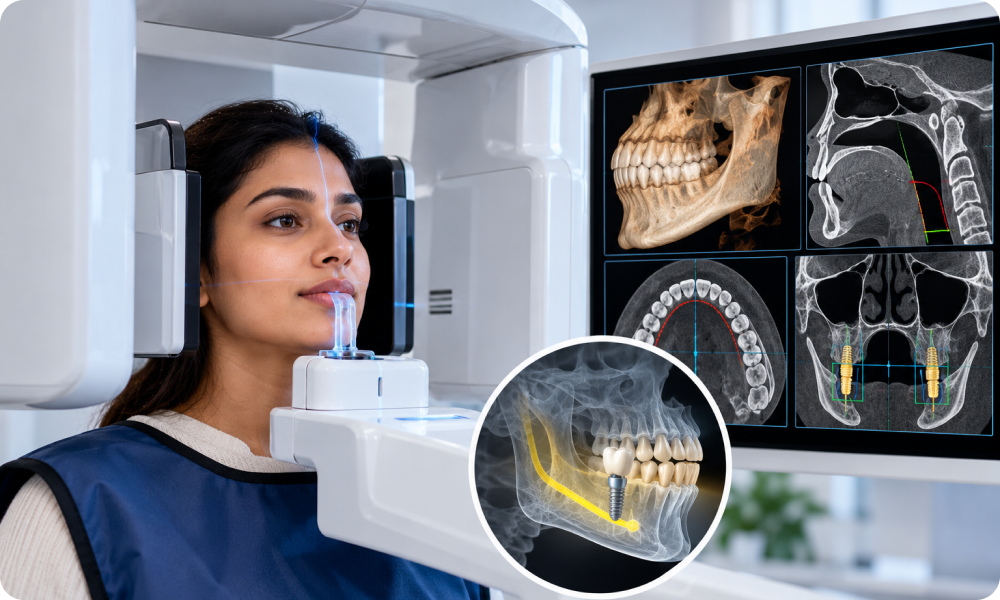
Cone beam CT gives us a millimetre-precise 3D view of
your teeth, roots, bone, sinuses, and jaw joint — at a fraction of the radiation dose of medical CT.
Cone beam computed tomography (CBCT) is a specialised X-ray technology that captures hundreds of 2D images in a single rotation and reconstructs them into a 3D volumetric dataset. Unlike medical CT, the cone-shaped beam geometry limits radiation to the region of interest — reducing dose by 90% or more compared to conventional CT scanning.
The clinical applications of CBCT in dentistry are transformative. Implant planning on a 2D panoramic X-ray is estimation; planning on a CBCT is precision — every nerve canal, every sinus anatomy variation, every millimetre of available bone is mapped before the first incision. Impaction assessment becomes three-dimensional. TMJ disc pathology is visualised in coronal, sagittal, and axial planes simultaneously.
At I Smile Clinic, CBCT is available on-site. We scan selectively — only when the clinical question cannot be answered by conventional imaging and when the result will change management. Every scan is reported by the prescribing specialist and discussed with patients.
Book a consultation with our specialists and receive a personalized treatment plan.

3D bone mapping identifies available volume, proximity to the inferior alveolar nerve and maxillary sinus, and optimal implant angulation.

CBCT shows the precise three-dimensional position of impacted wisdom teeth and canines — critical for surgical planning and risk assessment.

Bony condylar changes, degenerative joint disease, erosions, and cortical integrity of the joint are assessed in three planes simultaneously.

Vertical root fractures — invisible on periapical X-rays — are often detectable on CBCT, changing the decision between root canal and extraction.

The cross-sectional area of the airway at the level of the tongue base and soft palate is measurable — supporting sleep apnea and airway evaluation.

Cysts, tumours, and other jaw pathologies are characterised in three dimensions — guiding surgical planning and biopsy approach.

CBCT is prescribed only when the clinical question justifies the additional dose — and only when the result will change patient management.

The patient stands or sits in the CBCT unit for 10–20 seconds while the arm rotates around the head. No claustrophobia, no discomfort, no contrast injection.

Software reconstructs the volumetric dataset. Axial, coronal, sagittal, and curved reformats are generated automatically.

The prescribing specialist reviews the entire volume — not just the area of primary interest. Incidental findings are documented and communicated.

CBCT data feeds directly into implant planning software, surgical guide fabrication workflows, and orthodontic digital setups.
A small-field CBCT scan delivers 50–200 microsieverts — equivalent to 1–7 days of natural background radiation. A full-skull medical CT delivers 10–20 times more. The dose is justified when the diagnostic benefit is clear.
CBCT must be prescribed by a registered dental or medical professional with an identifiable clinical indication. It cannot be self-requested. We prescribe CBCT based on clinical need identified at examination.
The actual scan acquisition takes 10–20 seconds. You will be in the scan room for approximately 5 minutes total.
CBCT provides more information than a panoramic X-ray but at a higher dose. Panoramic X-rays remain appropriate for general screening. CBCT is reserved for specific clinical questions that 2D imaging cannot answer.

A titanium post anchored in the jawbone, topped with a custom ceramic crown — the closest science has come to replacing a natural tooth.

Accurate classification of your specific TMJ disorder is the foundation of effective treatment. Dr. Anu uses evidence-based diagnostic criteria (DC/TMD) to classify and target your condition precisely.

A handheld wand scans your teeth and gums in real time — producing a millimetre-accurate 3D model that feeds directly into aligner, crown, implant, and retainer workflows.
Our specialists will evaluate your case and design a treatment plan built around your goals.