The only tooth replacement that replaces the root —
providing a lifetime solution that preserves bone and restores full function.
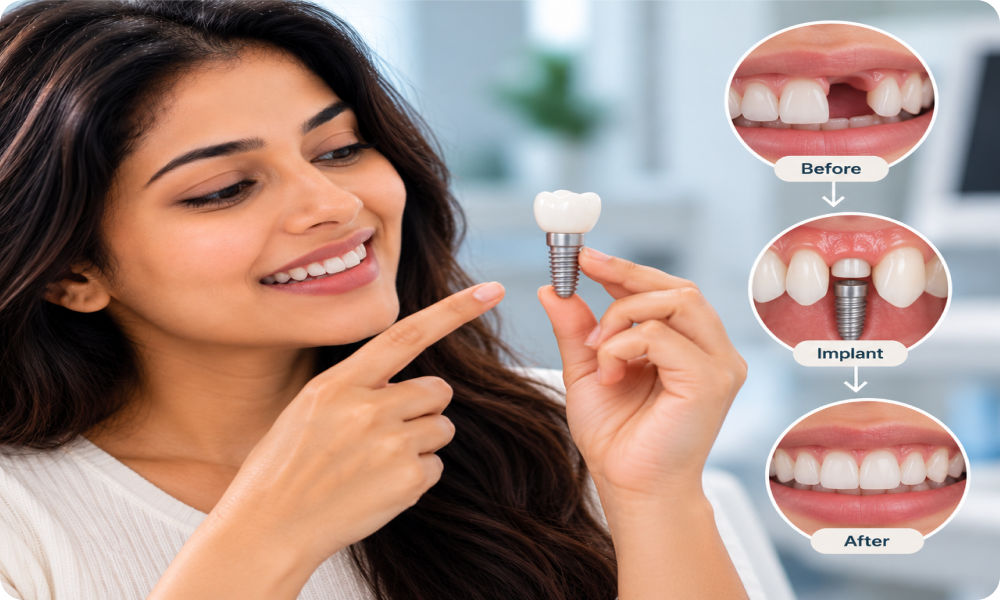
Dental implants are the most transformative development in restorative dentistry since the introduction of the dental drill. A titanium screw — roughly the size of a natural tooth root — is placed in the jawbone under local anaesthesia. Over 3–6 months, the bone fuses to the implant surface in a process called osseointegration, creating a biological bond indistinguishable from that of a natural root.
What distinguishes implants from all other tooth replacement options — bridges, dentures, partial plates — is that they preserve bone. When a tooth is lost, the bone that supported it begins to resorb within months. Implants stop this process, maintaining the facial structure and preventing the sunken appearance that characterises long-term tooth loss.
At I Smile Clinic, all implant planning is guided by CBCT imaging. We generate a surgical guide from the 3D scan, allowing us to place implants in precisely the planned position every time — improving both safety and the predictability of the prosthetic outcome.
Book a consultation with our specialists and receive a personalized treatment plan.

One implant and one crown replace a missing tooth without touching adjacent healthy teeth — unlike a traditional bridge.

Implant-supported bridges replace spans of missing teeth using the fewest possible implants, distributing bite forces across the arch.

All-on-4 and All-on-6 protocols restore an entire arch of teeth on four or six implants — usually without bone grafting.

Implant-retained overdentures click firmly onto two to four implants — eliminating the instability, sore spots, and dietary restrictions of conventional dentures.

Patients born without specific teeth (most commonly upper lateral incisors) benefit from single implants placed after facial growth is complete.

Implants placed at the time of extraction (immediate implant placement) minimise healing time and preserve the natural gum architecture.

3D bone mapping identifies implant position, angle, and depth. A surgical guide is fabricated to translate the virtual plan to the operating field.

Under local anaesthesia, the titanium implant is placed through a minimal incision using the surgical guide. Most patients return to work the following day.

3–6 months of osseointegration under a healing cap. A temporary restoration may be provided for aesthetic areas during this period.

The healing cap is replaced with an abutment, and a digital scan captures the final restoration geometry. A ceramic crown is fabricated and seated.

Annual implant reviews check integration status, peri-implant tissue health, and crown condition. Home care is identical to natural teeth — brush and floss.
Most adults in good general health are candidates. Sufficient bone volume (often augmented with grafting), controlled systemic disease, and non-smoking status improve outcomes. A CBCT scan determines suitability definitively.
Implants have documented survival rates of 95–98% at 10 years and frequently last a lifetime with proper care. The ceramic crown may eventually require replacement — typically after 15+ years.
Yes, but with reduced success rates. Smoking impairs blood supply and immune response, slowing osseointegration and increasing infection risk. We counsel patients to reduce or stop smoking before and after implant placement.
All-on-4 places four implants — two angled at 45 degrees to avoid the sinus or nerve — to support a full arch fixed bridge. It reduces the number of implants and often avoids bone grafting. Conventional implants replace individual teeth with individual implants.

Custom-fabricated ceramic crowns cap damaged teeth and restore their full form and function. Bridges span gaps using adjacent teeth as support — a time-tested fixed solution for missing teeth.

Replace missing teeth with natural-looking dental implants and prosthetics that restore both function and aesthetics.

CBCT scanning transforms dental diagnosis and treatment planning — revealing anatomy invisible on conventional X-rays and enabling guided surgery with unmatched precision.
Our specialists will evaluate your case and design a treatment plan built around your goals.